
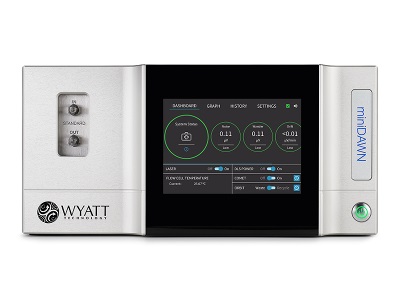
miniDAWN™ Multi-Angle Light Scattering (MALS) Detector for SEC-MALS
Manufacturer: Waters | Wyatt Technology
SKU: miniDAWN
Description
The miniDAWN™ from Wyatt Technology, a Waters company, is a multi-angle light scattering (MALS) detector used primarily in conjunction with size-exclusion chromatography (SEC-MALS). It determines absolute molar mass and size for macromolecules and nanoparticles in solution, covering a range from 200 Daltons to 10 Megadaltons, without reliance on column calibration standards. The instrument features high-gain photodiodes at three angles for static light scattering measurements and offers an optional integrated module for simultaneous dynamic light scattering (DLS) to determine hydrodynamic radii down to 0.5 nm. Key operational features include high sensitivity, requiring minimal sample mass, and a self-cleaning system using an embedded ultrasonic transducer to maintain cell integrity. The detector is designed for field serviceability with modular components and includes system-ready monitoring. It can be coupled with composition-gradient systems for the characterization of biomolecular interactions.
Specifications
| Item | miniDAWN™ Multi-Angle Light Scattering (MALS) Detector for SEC-MALS |
| Company | Waters | Wyatt Technology |
| Catalog Number | miniDAWN |
| Quantity | EA |
| Type | MALS and optional DLS |
| Detector(s) | High-gain, high-dynamic range photodiodes at 3 detection angles for MALS. Optional avalanche photodiode for simultaneous dynamic light scattering measurements. |
| Measuring Range | 200 Da to 10 Mda; 1MDa polymers |
| Dimensions | (WxDxH) 36 x 60 x 17 cm |
| Wavelength(s) | 658 nm ± 4 nm |
| Light Source | 658 nm laser, programmable from 10% to 100% maximum power. |
| Sample Type | Peptides, proteins, nucleic acids, small polymers, lipid nanoparticles, small viruses, and other macromolecules, rms < 50 nm |
| Applications | With SEC/GPC: determination of distributions of absolute molar mass, size, conformation, conjugate ratio. With Calypso CG-MALS: characterization of biomolecular interactions. |
| Interface | 7" high-resolution, color LCD multi-touch-screen display, and ASTRA host software |
| Measuring Time | Depedent on LC separation |
| Temperature Range | ambient |
| Sensitivity | 25 ng of 100 kDa polystyrene in THF, under typical GPC conditions0.5 µg of BSA under typical 30 cm column |
| Measurement Mode(s) | 3 angles |
| Radius of Gyration Range | Rg (rms radius): 10 nm to 50 nmRh(hydrodynamic radius): 0.5 nm to 50 nm or up to 1 µM (with optional DLS module, upper limit configuration-dependent) |
| Control | Programmable 10% - 100% (laser power) |
Vendors & Pricing
No vendors listed yet
Vendor pricing will appear here once available.