
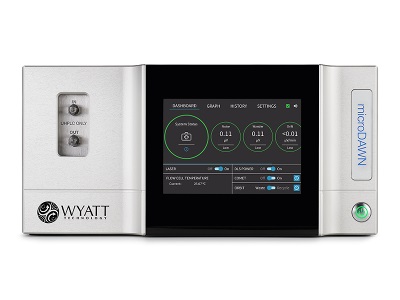
microDAWN™ Multi-Angle Light Scattering Instrument for UHP-SEC-MALS
Manufacturer: Waters | Wyatt Technology
SKU: microDAWN
Description
The microDAWN™ from Waters | Wyatt Technology is a multi-angle light scattering (MALS) detector engineered for integration with ultra-high performance liquid chromatography (UHPLC or UPLC) systems. Its primary function is the absolute characterization of macromolecules, such as proteins and polymers, as they elute from a size-exclusion chromatography (SEC) column. By measuring scattered light at three fixed angles, the instrument determines molar mass and size directly, independent of elution time or the need for column calibration standards. It is designed to maintain the high resolution of UHPLC separations, featuring minimal interdetector volume and band broadening to preserve narrow peak profiles. The detector offers a broad measuring range, capable of analyzing species from 200 Daltons up to 10 million Daltons, with particular utility for polymers around 1 MDa. While optimized for UHP-SEC-MALS, it may also be compatible with other chromatographic modes like ion-exchange. An optional dynamic light scattering (DLS) capability can be added to the core static light scattering (MALS) function.
Specifications
| Item | microDAWN™ Multi-Angle Light Scattering Instrument for UHP-SEC-MALS |
| Company | Waters | Wyatt Technology |
| Catalog Number | microDAWN |
| Quantity | EA |
| Type | MALS and optional DLS |
| Wavelength Range | Inquire |
| Detector(s) | High-gain, high dynamic range, static light scattering detectors at 3 angles |
| Measuring Range | 200 Da to 10 Mda; 1MDa polymers |
| Wavelength(s) | 660 nm |
| Control | Programmable 10% - 100% (laser power) |
| Dimensions | (WxDxH) 36 x 60 x 17 cm |
| Interface | 7" high-resolution, color LCD multi-touch-screen display, and ASTRA host software |
| Measuring Time | Depedent on LC separation |
| Applications | With SEC/GPC: determination of distributions of absolute molar mass, size, conformation, conjugate ratio. |
| Temperature Range | ambient |
| Sensitivity | 3.5 ng of 100 kDa polystyrene in THF, under typical GPC conditions70 ng of BSA under typical 30 cm column |
| Light Source | 660 nm laser, programmable 10% - 100% of maximum power. |
| Sample Type | Peptides, proteins, nucleic acids, small polymers, lipid nanoparticles, small viruses, and other small macromolecules compatible with UHPLC/UPLC |
| Measurement Mode(s) | 3 angles |
| Radius of Gyration Range | Rg (rms radius): 10 nm to 50 nmRh(hydrodynamic radius): 0.5 nm to 30 nm or up to 1 µM (with optional DLS module, upper limit configuration-dependent) |
Vendors & Pricing
No vendors listed yet
Vendor pricing will appear here once available.