
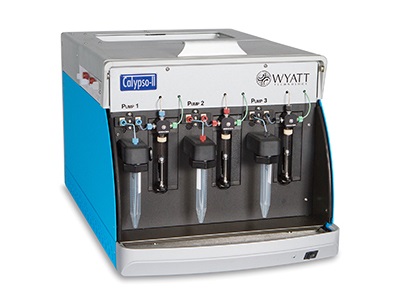
Calypso™ Biomolecular Interaction System
Manufacturer: Waters | Wyatt Technology
SKU: Calypso II
Description
The Calypso system is an analytical instrument that employs Composition-Gradient Multi-Angle Light Scattering (CG-MALS) to characterize interactions between biomolecules in solution. This label-free technique does not require sample immobilization. The system operates by flowing solutions with varying compositions and concentrations past a detection suite, which typically includes a multi-angle light scattering (MALS) detector, such as a DAWN or miniDAWN, and a concentration detector like a differential refractometer or UV/Vis spectrometer. The accompanying software analyzes the resulting data to quantify interaction parameters. These can encompass equilibrium dissociation constants (Kd), the absolute stoichiometry of complexes, second virial coefficients (A2), cross-virial coefficients, and kinetic data for processes like aggregation. A complete measurement typically takes about one hour, though the duration can range from 30 minutes to 10 hours depending on the protocol. The instrument has a compact footprint, measuring 37 cm in width, 58 cm in depth, and 35 cm in height.
Specifications
| Item | Calypso™ Biomolecular Interaction System |
| Company | Waters | Wyatt Technology |
| Catalog Number | Calypso II |
| Quantity | EA |
| Type | Composition-Gradient Multi-Angle Light Scattering (CG-MALS) |
| Detection System | MALS detectors: DAWN or miniDAWN Concentration detectors: Optilab® differential refractometer, UV/Vis absorption or similar |
| Measuring Time | 30 minutes to 10 hours; 1 hour typical |
| Dimensions | (WxDxH) 37 x 58 x 35 cm |
| Detector(s) | Requires a DAWN™ or miniDAWN™ MALS instrument. Recommended: Optilab™; RI detector or inline UV/Vis absorption detector for concentration, depending on application. |
| Sample Volume | Between 100 µg to tens of mg of sample, depending on binding affinity and molecular weight. High-affinity interactions such as antibody-antigen binding require about 100 µg of each protein. Second virial coefficient measurements require 20 - 30 mg of sample. |
| Measuring Range | KD from pM to mM |
| Sample Type | Proteins, nucleic acids, polymers and other macromolecules |
| Applications | Biopharmaceutical R&D, structural biology/virology. Reversible self-association, protein-protein binding, formulation development, kinetics of aggregation or self-assembly. |
| Interface | CALYPSO™ host software |
Vendors & Pricing
No vendors listed yet
Vendor pricing will appear here once available.