
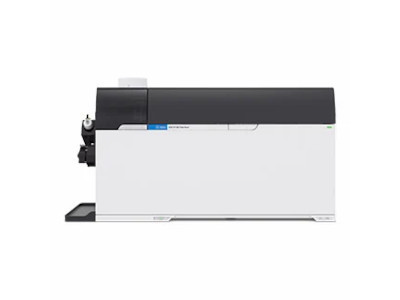
8900 Triple Quadrupole ICP-MS
Manufacturer: Agilent Technologies
SKU: 8900 Triple Quadrupole ICP-MS
Description
The Agilent 8900 is a triple quadrupole inductively coupled plasma mass spectrometer (ICP-QQQ) designed for analytical challenges beyond the capabilities of standard single quadrupole ICP-MS instruments. Its tandem mass spectrometry (MS/MS) configuration provides precise control over reaction chemistry within the collision/reaction cell, enabling the resolution of complex spectral interferences. This capability is critical for achieving extremely low detection limits in applications such as measuring ultra-trace contaminants in high-purity semiconductor chemicals or detecting nanoparticles. The system can effectively analyze elements like silicon, phosphorus, sulfur, chlorine, and fluorine, which are often problematic due to isobaric overlaps or polyatomic interferences. It incorporates a four-channel cell gas control system for flexible operation across multiple modes, including a helium collision mode for managing common polyatomic interferences. Engineered for robustness, the 8900 features a plasma condition that minimizes oxide formation (low CeO/Ce) and includes Ultra High Matrix Introduction (UHMI) technology to handle samples with total dissolved solids up to 25%. The instrument offers pre-configured method packages to simplify setup for routine analyses while maintaining the versatility required for advanced research applications, including precursor and product ion scanning modes.
Specifications
| Item | 8900 Triple Quadrupole ICP-MS |
| Company | Agilent Technologies |
| Catalog Number | 8900 Triple Quadrupole ICP-MS |
| Quantity | EA |
| Applications | Demanding applications that cannot be run well enough using single quadrupole ICP-MS. These applications may require extremely low detection limits, for example measuring ultra-trace contaminants in semiconductor process chemicals and high-purity materials or detecting the smallest nanoparticles. To resolve isobaric, doubly charged, and adjacent mass overlaps as well as intense polyatomic interferences. This capability allows low-level analysis of unusual analytes such as Si, P, S, Cl, and even F. |
Vendors & Pricing
No vendors listed yet
Vendor pricing will appear here once available.